
Many homeowners expect to call one mold company that finds the problem, cleans it up and says it is fixed. In Texas, on a licensed project, that is not how it works. State law separates the person who assesses mold from the person who removes it, and a third step, clearance, has to come from the assessment side again. This post explains who regulates mold in Texas, what Texas Occupations Code §1958.155 says, and how the protocol, clearance and the MDR-1 certificate fit together for a Lubbock homeowner.
This is general information, not legal advice. Texas mold rules are set by statute and TDLR rule, and SB 1255 (2025) changed parts of the law while TDLR updates its rules. For a question about your own situation, check with TDLR or a Texas attorney.
Who regulates mold in Texas?
The Texas Department of Licensing and Regulation (TDLR) runs the mold program, under rules adopted by the Texas Commission of Licensing and Regulation. The statute is Texas Occupations Code chapter 1958, and TDLR's mold rules are in 16 Texas Administrative Code chapter 78. According to TDLR's FAQ, the program moved from the Department of State Health Services to TDLR on November 1, 2017, and "All DSHS mold license numbers transferred to TDLR."
TDLR licenses both sides of a project: mold assessment consultants and companies on one side, and mold remediation contractors and companies on the other. Our guide on how to verify a TDLR mold license lists every license type.
What §1958.155 says
Texas Occupations Code §1958.155 contains the conflict-of-interest rule:
- Subsection (a): "A license holder may not perform both mold assessment and mold remediation on the same project."
- Subsection (b): "A person may not own an interest in both the entity that performs assessment services and an entity that performs remediation services on the same project."
- Subsection (d) carves out school-district employees working on their own district's projects.
TDLR's FAQ adds a point that surprises people: a firm can hold both an assessment and a remediation license. "However, you are not allowed to conduct both mold assessment and mold remediation activities on the same project." TDLR's enforcement schedule lists "Performed both mold assessment and remediation on the same project" and "Owned interest in an entity that performs both mold assessment and remediation on the same project" as violations.
Put neutrally: in Texas, the assessor and the remediator on the same project must be separate, and no one may own an interest in both.
Why the split exists
The statute does not explain its reasoning in the text, but the structure is easy to follow. The assessor defines the problem and the scope of work, then checks whether the work met that scope. The remediator does the work. Keeping those roles in different hands means the company being paid for the cleanup is not the one deciding how much cleanup is needed or whether it passed. For a homeowner, the practical effect is two separate bids and two separate firms.
The licensed project, step by step
For a hired job of 25 contiguous square feet or more (the threshold explained in our 25 square foot rule post), the sequence looks like this:
Assessment and protocol
A licensed mold assessment consultant inspects the property and writes a mold remediation protocol. Under 16 TAC §78.52, the consultant puts a license number and expiration date on each report and plan.
Work plan
The separate licensed remediator prepares a work plan to carry out the protocol. 16 TAC §78.58 requires "the license number and license expiration date on the cover page."
TDLR notification
For 25 contiguous square feet or more, 16 TAC §78.110 requires the remediator to notify TDLR "no less than five calendar days before the anticipated start date." In an emergency, Texas Occupations Code §1958.153(b) allows notice "not later than the next business day."
Remediation
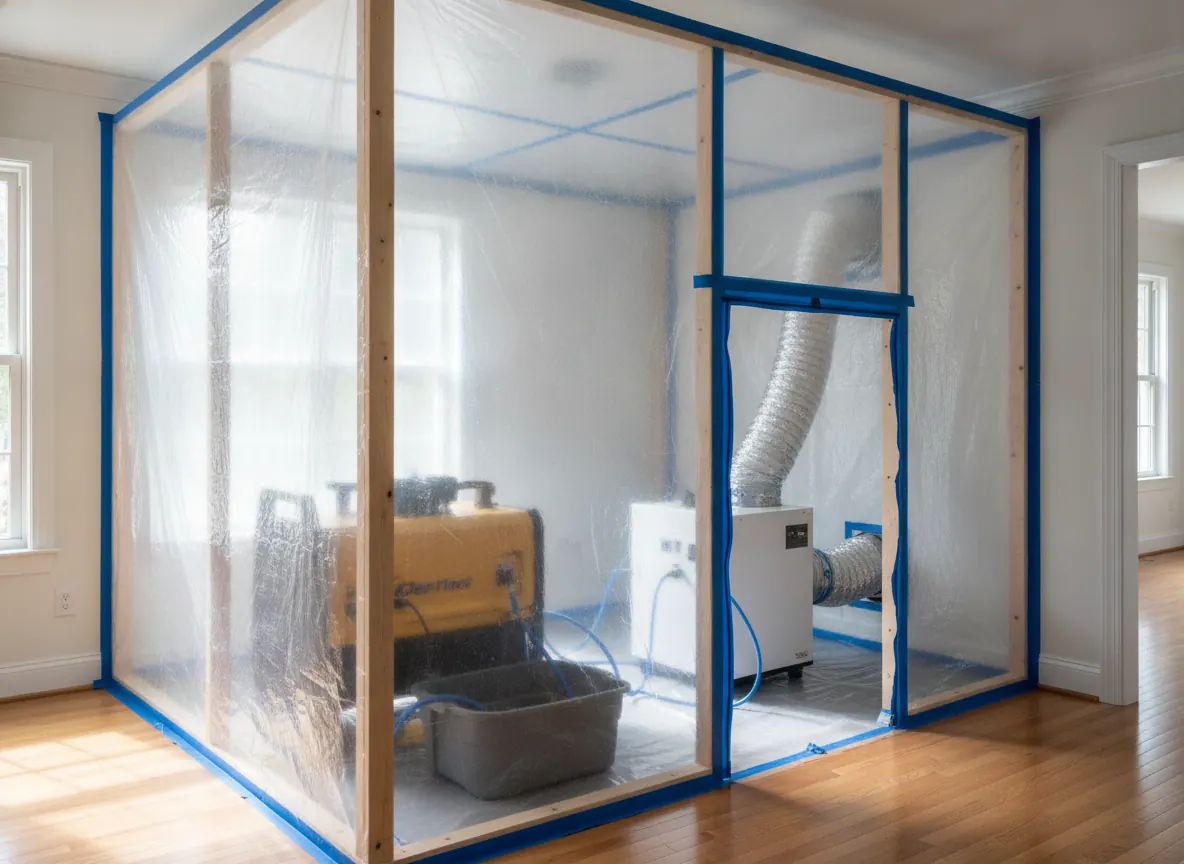
The remediator does the work described in the protocol. During remediation, crews typically set up containment around the affected area and remove or clean materials as the plan specifies.
Clearance
A licensed assessor performs the post-remediation assessment (see below).
Certificate
The owner receives the Certificate of Mold Damage Remediation, TDI form MDR-1, within 10 days.
See our mold remediation process page for a homeowner's view of each stage.
What clearance means in Texas
16 TAC §78.140(a) says: "For a remediation project to achieve clearance, a licensed mold assessment consultant shall conduct a post-remediation assessment using visual, procedural, and analytical methods." The consultant must determine whether "(1) the work area is free from all visible mold and wood rot; and (2) all work has been completed in compliance with the remediation protocol and remediation work plan." Under §78.140(d), the consultant "shall issue a written passed clearance report to the client."
One catch for do-it-yourselfers: TDLR's FAQ says a consultant "who has not prepared a mold remediation protocol in advance of a remediation project cannot declare that the project has achieved clearance." If you think you will want a certificate later, involve a licensed assessor before the work starts, not after.
The MDR-1 certificate
Texas Occupations Code §1958.154(a): "Not later than the 10th day after the date on which a license holder completes mold remediation at a property, the license holder shall provide a certificate of mold remediation to the property owner."
16 TAC §78.150 fills in the details. The remediation contractor or company provides "a Certificate of Mold Damage Remediation to the property owner on a form adopted by the Texas Commissioner of Insurance." That form is TDI Form MDR-1. It includes "a statement by a licensed mold assessment consultant (not the licensed mold remediator)" that the contamination "has been remediated as outlined in the mold remediation protocol." Under §78.150(a), before and after photos also go to the owner within 10 calendar days.
Why homeowners keep it
- Insurance: TDLR's FAQ says a qualifying certificate "may be presented to an insurer who may not make an adverse underwriting decision regarding a residential property insurance policy based on previous mold damage" if the requirements are met, citing Insurance Code §544.303(a)(4)(B).
- Selling: under §1958.154(b), a seller "shall provide to the buyer a copy of each certificate issued for the property under this section during the five years preceding" the sale.
- Liability: §1958.303 says an owner "is not liable for damages related to mold remediation" if a certificate was issued and the damages "accrued on or before the date of the issuance of the certificate."
What it means for your budget
Because a licensed job of this size involves two separate licensed firms, an assessor for the protocol and clearance and a remediator for the work, budget for both. Typical national ranges from cost guides put a mold inspection at about $450–$800 and inspection plus remediation for an average home at about $1,950–$5,800. These are estimates, not quotes; the real price comes from licensed pros after an on-site assessment. Our cost guide has the full table.
A note on 2025 changes
SB 1255 (2025) amended chapter 1958, and TDLR says it is updating its rules. TDLR states that current rules "remain in effect until new administrative rules, procedures and definitions have been formally adopted." None of the provisions quoted in this post were reported as changed, but check TDLR for updates.
Getting two quotes the right way
We connect Lubbock-area homeowners with TDLR-licensed mold assessors and remediators for free, no-obligation quotes, and we keep the two roles separate: one quote for assessment, another for remediation. Ask any company for its TDLR license number and check it on TDLR's license search. Tell us what you're seeing, or read more about mold inspection and testing and mold removal. Call (727) 300-6656
Frequently asked questions
Can my mold inspector also do the mold removal in Texas?
Not on the same project. Texas Occupations Code §1958.155(a) says a license holder may not perform both mold assessment and mold remediation on the same project, and §1958.155(b) bars anyone from owning an interest in both the assessment and the remediation firm on that project. Expect two separate companies. This is general information, not legal advice.
What is a TDLR licensed mold assessment consultant?
It is the Texas license for the professional who assesses mold. Under 16 TAC §78.140, a licensed mold assessment consultant performs the post-remediation assessment that decides whether a project achieves clearance. On licensed jobs, the consultant also writes the remediation protocol the remediator follows. This is general information, not legal advice.
What is the MDR-1 form?
MDR-1 is the Texas Department of Insurance form for the Certificate of Mold Damage Remediation. Under Texas Occupations Code §1958.154 and 16 TAC §78.150, the remediator provides it to the owner within 10 days of finishing, with a statement from the licensed assessment consultant. This is general information, not legal advice.